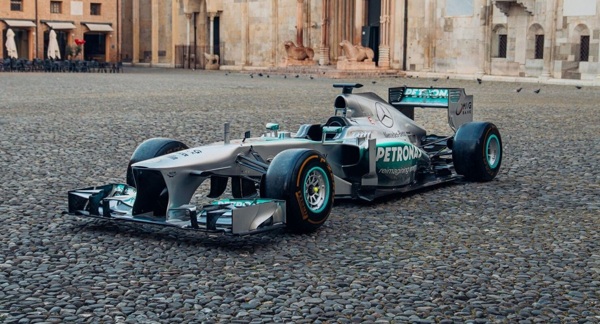
After 14 of 23 rounds in 2026, the Formula 1 drivers standings read like a Mercedes internal memo. Kimi Antonelli sits on 292 points with eight wins, 81 clear of teammate George Russell, and prediction markets have him at roughly 91 percent implied probability to take the title. Back in March, before a single race, Russell was the one drawing the shortest price at around +225. That gap between the February board and the September board is the whole story of how these markets work.
Odds aren’t predictions handed down from someone who knows the future. They’re prices, and prices move.
Most people first meet a title price on a sportsbook screen rather than in a spreadsheet. Platforms like BetFury list the drivers championship next to race winner and pole position markets, and those numbers can shift inside ten minutes of a qualifying session going sideways. Anyone who chooses to play for real money on a futures market is really disagreeing with the trader who set the line, not forecasting a season in the abstract.
That framing changes what you look for. A fan checking the same board in early March 2026 would have seen Russell short, Max Verstappen next, and a 19-year-old Italian rookie priced as an afterthought. By late May, after four straight wins, Antonelli was already odds-on at about -140. Nobody re-ran a simulation from scratch. The market just kept correcting itself, race by race, the way it always does.
What a Title Price Actually Represents
Convert any odds figure into a percentage and you get the implied probability. American odds of -400 work out to 80 percent. Decimal odds of 1.25 give the same answer. Add up the implied probabilities across every driver in a title market, though, and the total lands somewhere near 105 to 115 percent rather than 100.
That surplus is the margin. It’s how the book earns money regardless of who lifts the trophy in Abu Dhabi.
So when a source quotes Antonelli at 91 percent, the “true” estimate sitting behind it is probably a few points lower. Traders build in cushion, especially on futures markets that stay open for eight months and tie up liability the entire time.
The Inputs Traders Weigh Before Setting a Number
Pricing a drivers championship is less exotic than it sounds. The bulk of the work is arithmetic plus a handful of judgment calls that nobody can fully model.
- Points already banked, and how many rounds plus sprints remain. With nine races left in 2026, an 81-point deficit is a mountain, not a hill.
- Raw car pace measured across a season, usually from qualifying gaps and race stint data rather than headline results.
- Reliability history, including power unit component allowances. Antonelli’s grid penalty at Monza came straight out of that ledger.
- Circuit fit for the rest of the calendar. Some cars love high-speed corners and hate slow ones.
- Team orders risk, which is the single hardest thing to price and the most relevant factor for Mercedes this year.
- Money already in the market. If thousands of people backed Russell in February, the book carries that exposure all season and prices accordingly.
Weather, stewards decisions, and a driver’s contract situation feed in too, though at much smaller weights.
Why Mercedes Dominates the 2026 Board
The Silver Arrows got the 2026 regulation reset right. New power unit rules arrived this season with a near 50-50 split between internal combustion and electrical energy, and Mercedes evidently understood the deployment problem better than anyone else on the grid. That advantage shows up in the constructors table, where Mercedes has been comfortably clear of Ferrari since midsummer.
Traders don’t price a car directly. But car pace is baked into every driver line on the board, which is why both Mercedes drivers spent most of 2026 in the top four of the market while Verstappen, a four-time champion, drifted out past +4000 in some places. The Red Bull was simply off the pace, and no amount of talent fixes a deficit that size over a full season. You can see the same effect in reverse with Lando Norris, who climbed the board after back-to-back wins at the Hungarian and Dutch Grands Prix before sliding again once Antonelli restarted his run of victories. Official round-by-round results are published at Formula1.com, and the regulations that shape all of this sit with the FIA.
The Teammate Problem Nobody Prices Well
Here’s where Mercedes gets awkward for anyone setting a line. Two drivers, one car, identical equipment. Standard models handle that badly, because they assume drivers compete against the field rather than against each other for the same team’s resources.
A few things traders have to guess at:
- Whether the team starts favouring the points leader in strategy calls, which shortens the leader’s price and lengthens the teammate’s
- How a 20-year-old handles title pressure over nine remaining rounds, given he had never won a Grand Prix before this year
- Whether Mercedes risks a double DNF by letting them race hard, as happened in the closing laps at Monza
- The chance of a mechanical failure hitting one car and not the other
Russell’s problem is mathematical. To close 81 points across nine rounds he’d need to outscore Antonelli by roughly nine points per race, which means winning almost everything while his teammate finishes off the podium repeatedly. Antonelli has missed the podium twice in 14 starts, and one of those was a retirement. That’s why his price barely flinched even when he qualified 19th at Monza on September 6, 2026, then carved through the field to win anyway.
Reading a Mercedes Price Without Getting Burned
Watching the 2026 market week by week taught a fairly blunt lesson: the big moves happen on information, not results. Antonelli’s number jumped from 72 percent to 86 percent in three days around the Italian Grand Prix, and most of that move landed before the race. Traders had already worked out that a grid penalty at the fastest track on the calendar, where overtaking is actually possible, wasn’t the disaster the headline suggested.
Practical things worth checking before trusting a futures number:
- Compare implied probability across two or three sources to see the real margin
- Check when the price last updated. Stale futures boards are common
- Watch power unit allocation news, which telegraphs penalties weeks ahead
- Remember that an odds-on favourite offers thin returns, which is why race-by-race and head-to-head markets often attract more interest late in a season
A price of 91 percent still means something fails roughly one time in eleven. Cars break. Drivers crash. Antonelli’s own car failed him at Silverstone in July, handing Russell 15 points of ground in a single weekend.
Frequently Asked Questions
Why was George Russell the pre-season favourite if Antonelli is winning?
Pre-season prices lean heavily on the previous year plus winter testing. Russell finished fourth in 2025 and led a Mercedes that looked quick in February running, while Antonelli was a second-year driver without a victory. The market corrected once actual races happened.
Do bookmakers know something fans don’t?
Rarely. They watch the same timing screens and read the same technical press. Their edge is margin and volume, not secret information.
What does -400 mean in plain terms?
You’d need to risk $400 to win $100. That’s an 80 percent implied probability before margin is stripped out.
Can title odds change without a race happening?
Yes, and often. Engine penalties, driver contract news, and team upgrade announcements all move numbers during a break.
Why do the two Mercedes drivers have such different prices when the car is identical?
Points, mostly. Antonelli’s eight wins and 81-point cushion do the work. Perceived team support and current form account for the rest.