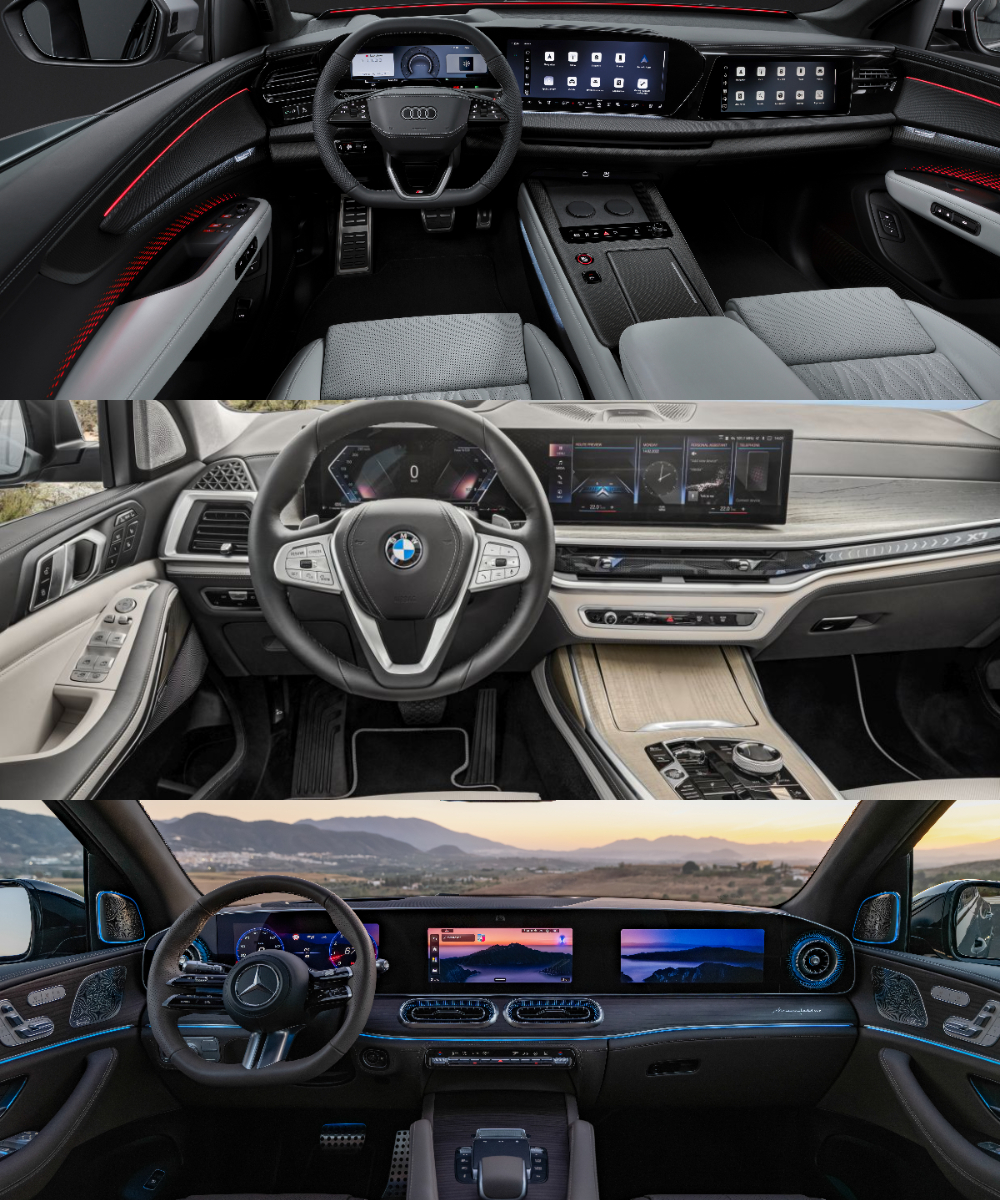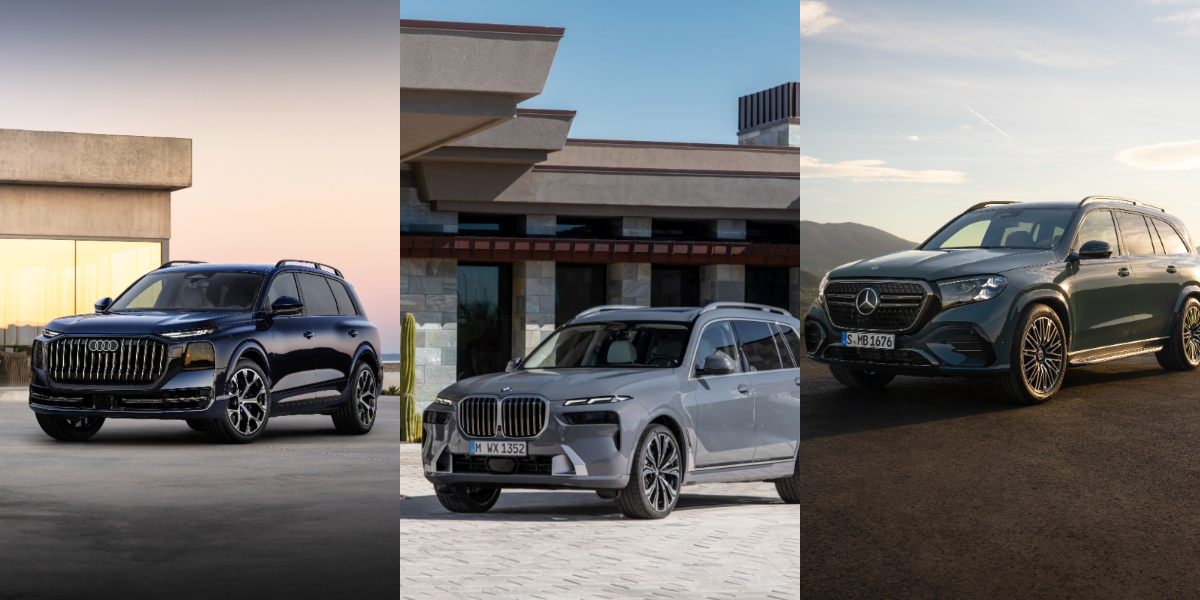
Immediately after the facelift of the Mercedes GLS, Audi unveiled the first ultra-luxury SUV in its history, the Audi Q9. This sets the stage for a new battle among Germany’s three premium SUV flagships: the Audi Q9, BMW X7, and Mercedes GLS. Which one offers the better overall package?
It may come as a surprise, but Audi has initially launched the new Q9 exclusively with a 3.0-liter V6 TDI diesel engine producing 299 hp.
Because it comes with seven seats as standard, the Mercedes GLS is not available as a plug-in hybrid, as there is not enough space beneath the luggage compartment floor to accommodate the battery. As a result, the GLS range consists of the GLS 350 d 4Matic and GLS 450 d 4Matic diesel models, the GLS 450 4Matic and GLS 580 4Matic gasoline versions, as well as the performance-oriented Mercedes-AMG GLS 63 4Matic+ and the ultra-luxurious Mercedes-Maybach GLS 680. The latter is available exclusively as a five-seater and is powered solely by a mild-hybrid V8 engine.
Likewise, the BMW X7 is also unavailable as a plug-in hybrid because it, too, features seven seats as standard. The lineup therefore includes the X7 xDrive40d diesel, the X7 xDrive40i gasoline model, and the X7 M60i xDrive equipped with a 4.4-liter twin-turbocharged V8 engine.
Since the Audi Q9 is currently offered only with a diesel engine, we selected the Mercedes GLS 450 d 4Matic, BMW X7 xDrive40d, and Audi Q9 V6 TDI for this initial comparison.
Dimensions and practicality
At 5,307 mm, the Audi Q9 is the longest of the three. The Mercedes GLS measures 5,209 mm, while the BMW X7 is the shortest at 5,181 mm. However, Audi’s greater overall length is not reflected in its wheelbase. The Q9 has a wheelbase of 3,138 mm, only slightly longer than the Mercedes GLS at 3,135 mm, while the BMW X7 measures 3,105 mm.
The Audi is also the widest, at 2,010 mm, with the BMW close behind at 2,000 mm. The Mercedes GLS is noticeably narrower at 1,956 mm. In terms of height, however, the BMW X7 leads with 1,835 mm, followed by the GLS at 1,823 mm, while the Audi is the lowest of the trio at 1,768 mm.
Although it is the most compact of the three, the Mercedes GLS is the heaviest, tipping the scales at 2,615 kg. The Audi Q9 follows closely at 2,605 kg, while the BMW X7 is the lightest at 2,565 kg and also offers the highest payload capacity, at 835 kg (compared with 760 kg for the GLS and 720 kg for the Q9). All three SUVs have a maximum braked towing capacity of 3,500 kg and an unbraked towing capacity of 750 kg.
The Audi’s greater length gives it a clear advantage in luggage space. With all seven seats in place, the Audi Q9 offers the largest cargo capacity at 539 liters, compared with 335 liters for the Mercedes GLS and 326 liters for the BMW X7. However, when both the second and third rows are folded flat, the Mercedes GLS takes the lead with a maximum cargo capacity of 2,400 liters, followed by the Audi Q9 with 2,308 liters and the BMW X7 with 2,120 liters.